
day,
00
month 0000
month 0000
Time:

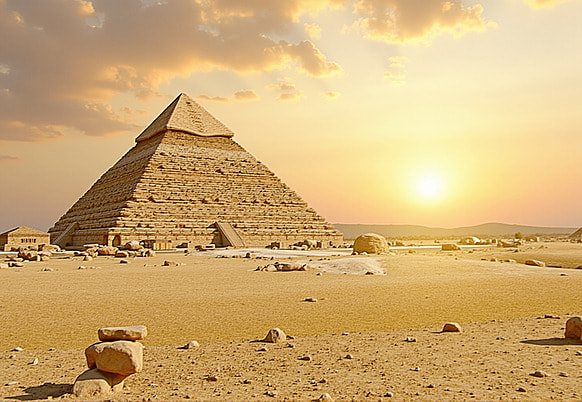

The pyramids of Egypt are among the most mysterious, iconic, and awe-inspiring structures ever created. More than just giant stone buildings, they represent the scientific knowledge, cultural beliefs, and engineering mastery of one of the world’s oldest civilizations. Today, millions of visitors travel to Giza to witness these ancient wonders, which continue to stand strong after thousands of years.
In ancient Egypt, pyramids were constructed mainly as royal tombs for the Pharaohs (kings). Egyptians believed that the Pharaoh was the earthly representative of the gods, and after death, he would begin a new life in the spiritual world.
So, pyramids served these purposes:
To preserve the Pharaoh’s body (mummification)
To store treasures, jewels, and valuable items for the afterlife
To symbolize power, faith, and eternal life
To ensure the Pharaoh’s journey to the next world
Pyramid building began around 4,700 years ago, during the Old Kingdom period of ancient Egyptian history.
The first pyramid ever built was the Step Pyramid of Djoser, designed by the legendary architect Imhotep.
Built around 2560 BCE
Originally 146.6 meters tall (today 138.8 m)
Held the record as the tallest human-made structure for 3,800 years
Constructed using about 2.3 million stone blocks
Built by Khufu’s son
Famous for being connected to the Great Sphinx of Giza
Seems taller due to its position on higher ground
Smallest of the three
Known for intricate design and craftsmanship
These three together form the Giza Pyramid Complex, one of the most celebrated archaeological sites in the world.
The construction of pyramids is still a topic filled with mystery, but historians believe:
20,000–30,000 skilled workers participated
Construction took 20–30 years
Massive stone blocks weighing 5–80 tons were moved using sledges, wooden rollers, and ramps
Perfect alignment with the four cardinal directions shows advanced knowledge of astronomy
Geometry, mathematics, and engineering sciences were highly developed in ancient Egypt
Even today, scientists are amazed at the precision of their architecture.
Many unanswered questions make pyramids even more fascinating:
How were such heavy stones transported without machines?
How did the builders achieve perfect alignment with north, south, east, and west?
How were the hidden chambers and long tunnels designed?
What tools did they use to cut and shape huge stone blocks?
These mysteries continue to attract researchers and travelers from around the world.
The ancient Egyptians believed:
The soul (Ka) continues after death
The Pharaoh becomes eternal and divine
The pyramid shape symbolized the sun’s rays
The structure helps the Pharaoh ascend to heaven
Thus, pyramids were sacred monuments filled with spiritual meaning.
In modern times:
The Giza pyramids are a UNESCO World Heritage Site
They are the last surviving wonder of the Seven Wonders of the Ancient World
They remain a major source of tourism for Egypt
Scientists continue to explore their hidden passages using modern technology
Despite thousands of years, the pyramids stand as proof of the brilliance of ancient civilization.

Our blog is a place where knowledge, curiosity, and creativity come together. We explain the world in simple, clear, and meaningful ways—whether it’s history, technology, news, or everyday life. Every article is written to inform, inspire, and help you learn something new.